What is neuroblastoma?
Neuroblastoma is the most common solid tumour of childhood. It is almost exclusively a childhood cancer occurring most commonly between the ages of 0-5 years. It results from immature nerve cells within the sympathetic nervous system.
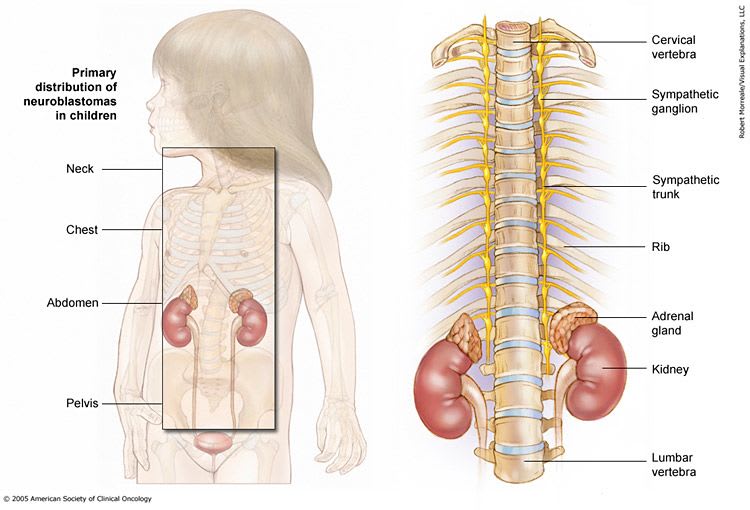
We gratefully acknowledge the American Society of Clinical Oncology Cancer.Net for permission to use the image below.
Let's start with the name
The word ‘neuroblastoma’ is a portmanteau derived from two terms:
- neuro = nerves
- blastoma = a cancer that affects immature or developing cells.
So, neuroblastomas are cancers that start in early nerve cells (called neuroblasts) of the sympathetic nervous system.
This means that tumours can be found anywhere along this system; most commonly (about 50%) start in the adrenal glands (above the kidney), or near the spine, chest, neck or pelvis.
Rarely, a neuroblastoma has spread so widely by the time it is found, doctors can’t tell exactly where it started.
Some neuroblastomas grow and spread quickly, while others grow slowly.
How common is neuroblastoma?
Neuroblastoma is a rare childhood cancer with about 40 children diagnosed with neuroblastoma each year in Australia (approximately, a child is diagnosed every nine days).
There is a chance of 1 in 100,000 of a child being diagnosed with neuroblastoma. There appears to be no trend in an increasing number of cases in Australia.
Why does this cancer form?
There are no known reasons as to why this childhood cancer occurs and there are no clear environmental links. There are rare cases where neuroblastoma runs in families due to a genetic mutation, but in most cases there is no known genetic cause.
How is it diagnosed?
Neuroblastoma may be difficult to diagnose as symptoms often do not become apparent until the tumour has reached a certain size. Even then symptoms may be subtle and similar to other more common non-serious childhood diseases. As a result it often takes some time before the final diagnosis of neuroblastoma is made.
Often parents wonder if they or a doctor should have noticed something sooner, but because it is such a rare disease it is unlikely that a family doctor will ever see a child with neuroblastoma in a lifetime of practice.
How dangerous is neuroblastoma?
Neuroblastoma is a very complex childhood cancer and there are many different types that behave very differently.
At one end of the spectrum are benign tumours that may even resolve spontaneously, while at the other end are aggressive tumours with an average survival rate of only 50%.
The cure rate for these “high-risk” tumours has only improved marginally in recent years, but there is clear hope that this rate will change with some new drug discoveries coming through.
Please note that all content provided by Neuroblastoma Australia is of a general nature only. Any medical queries should be directed to your oncologist or medical team.
On this page

Helpful Resources for Families
Explore practical information, support and guidance for every stage of the neuroblastoma journey.
Free Activity Guide
Newly Diagnosed
Find essential information for the early stages, including:
On Treatment
Learn more about what to expect during treatment, including:
- Treatments and side effects
- Clinical trials
Living with Neuroblastoma
Practical guidance for day-to-day family life, including:
Support and Connection
Connect with others and access extra support through: